
The world of digital storage keeps changing. SSDs now dominate over HDDs36 in laptops, desktops, and beyond. Below, I answer three common questions about SSDs37 based on referenced industry data.
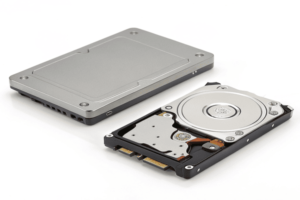
Unlike HDDs, SSDs handle read/write operations through a controller that distributes data across flash cells, manages wear leveling, and supports features like Unlike HDDs, SSD36s handle read/write operations through a controller that distributes data across flash cells, manages wear leveling, and supports features like TRIM for cleaning up unused data
Table: Key Differences
| Feature | 256GB SSD | 1TB HDD |
|---|---|---|
| Speed | Much faster | Slower |
| Capacity | Smaller | Larger |
| Reliability | Higher (no moving parts) | Lower (mechanical parts) |
| Power Usage | Lower | Higher |
| Noise | Silent | Audible |
| Price | Higher per GB | Lower per GB |
| Shock Resistance | Better | Worse |
| Heat Output | Lower | Higher |
| Data Recovery | Complicated | Easier |
If fast boot times and responsiveness are critical—especially for laptops, gaming, or professional tasks—the SSD brings noticeable improvements [1][2][3][4]. If you mostly need large storage for backups or mass data, the 1TB HDD saves money [1][2][8]. For many users, starting with an SSD for performance and supplementing with an HDD for bulk storage gives the best of both worlds [1][2][3][8].
What is the lifespan of a 1TB SSD?
The lifespan of a 1TB SSD is determined mainly by the number of write cycles (TBW—Total Bytes Written), The lifespan of a 1TB SSD is determined mainly by the number of write cycles (TBW—Total Bytes Written36), Drive Writes Per Day (DWPD), and usage patterns
Most SSDs today feature endurance ratings between 300 and 600 TBW for the 1TB range, which can cover many years of regular use [4][9][12]. For instance, Samsung’s 850 Pro 1TB SSD is rated for 300 TBW and a 10-year warranty, meaning writing roughly 40GB a day for ten years [12]. Real-world studies, including a multi-year test by Google and the University of Toronto, show SSD failure rates are often determined more by drive age than data volume, and SSDs tend to be replaced 25% less often than HDDs [9][12].
Failure modes differ. SSDs have limited write cycles, managed by wear leveling; as cells get used up, spare ones take over [1][4][9][12]. Most users will never reach the advertised TBW limit. Heavy enterprise use can result in a shorter lifetime, while lighter consumer use can extend it for many years [9][12]. Proper backup is always recommended, since data recovery from SSDs is more complex than mechanical drives due to features like TRIM that erase deleted data permanently [1][4][9][12].
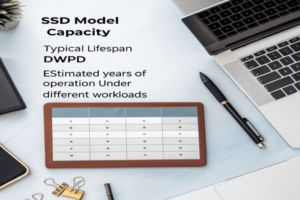
Summary Table: SSD Lifespan Factors
| Factor | Typical Value for 1TB SSD | Effect on Lifespan |
|---|---|---|
| TBW (Total Bytes Written) | 300–600 TB | Higher TBW = longer lifespan |
| DWPD (Drive Writes/Day) | 0.3–1 DWPD | Higher DWPD = greater endurance |
| Warranty | 5–10 years | Replacement if defective |
| Use Case | Consumer: 5–10 years | Enterprise: sometimes lower |
| Age/Spare Cells | More in larger SSDs | Extends usable life |
In summary, a good quality 1TB SSD will serve most users for 5–10 years or longer under normal use [4][9][12]. Enterprise environments and heavy write workloads require attention to TBW and warranty. Regular backups are essential for all storage devices [12].
Conclusion
An SSD, or Solid-State Drive, is an electronic storage device that’s fast, reliable, and durable. A 256GB SSD gives speed and responsiveness; a 1TB HDD offers cheap bulk storage. A 1TB SSD commonly lasts 5–10 years or more [1][2][3][4][8][9][12].
-
Understanding TBW helps you gauge SSD durability and performance, ensuring you choose the right drive for your needs.
(DWPD), and usage patterns [1][4][9][12]. Modern consumer SSDs commonly last anywhere from 5 to 10 years under typical conditions [1][4][9][12]. Larger SSDs, such as 1TB models, tend to last longer than smaller ones because spare blocks are available for replacing worn cells [4][9][12]. ↩ ↩ ↩ -
Explore this link to understand why SSDs are preferred for speed and reliability in modern computing.
now dominate over HDDs in laptops, desktops, and beyond. Below, I answer three common questions about SSDs based on referenced industry data.What does an SSD stand for?
SSD stands for Solid-State Drive. It is a type of storage device that uses integrated circuits—usually NAND flash memory—to store data persistently with no moving parts, unlike traditional hard disk drives that rely on spinning platters and a moving read/write head [2][3][4][5]. SSDs are also sometimes called solid-state storage devices or semiconductor storage devices [2][3]. They store data in memory cells, which can be accessed electronically and instantly, resulting in much faster speeds than mechanical drives [2][3][4][5]. ↩