

Selecting the correct server RAM often creates severe h […]
Selecting the correct server RAM often creates severe headaches for IT procurement teams when standard memory modules trigger unexpected platform boot failures. Many buyers assume that any module with an error-checking label will function inside modern enterprise chassis. In reality, choosing memory is an architectural alignment exercise between processor topology, electrical buffering, and continuous round-the-clock workload stability.
Servers primarily use Error-Correcting Code (ECC) memory deployed in Registered DIMM (RDIMM) or Load-Reduced DIMM (LRDIMM) architectures, rather than standard consumer unbuffered RAM. These enterprise modules feature dedicated hardware registers or data buffers that stabilize electrical loads, maintain signal integrity across multi-channel motherboards, and prevent silent data corruption during continuous, high-density enterprise computing.
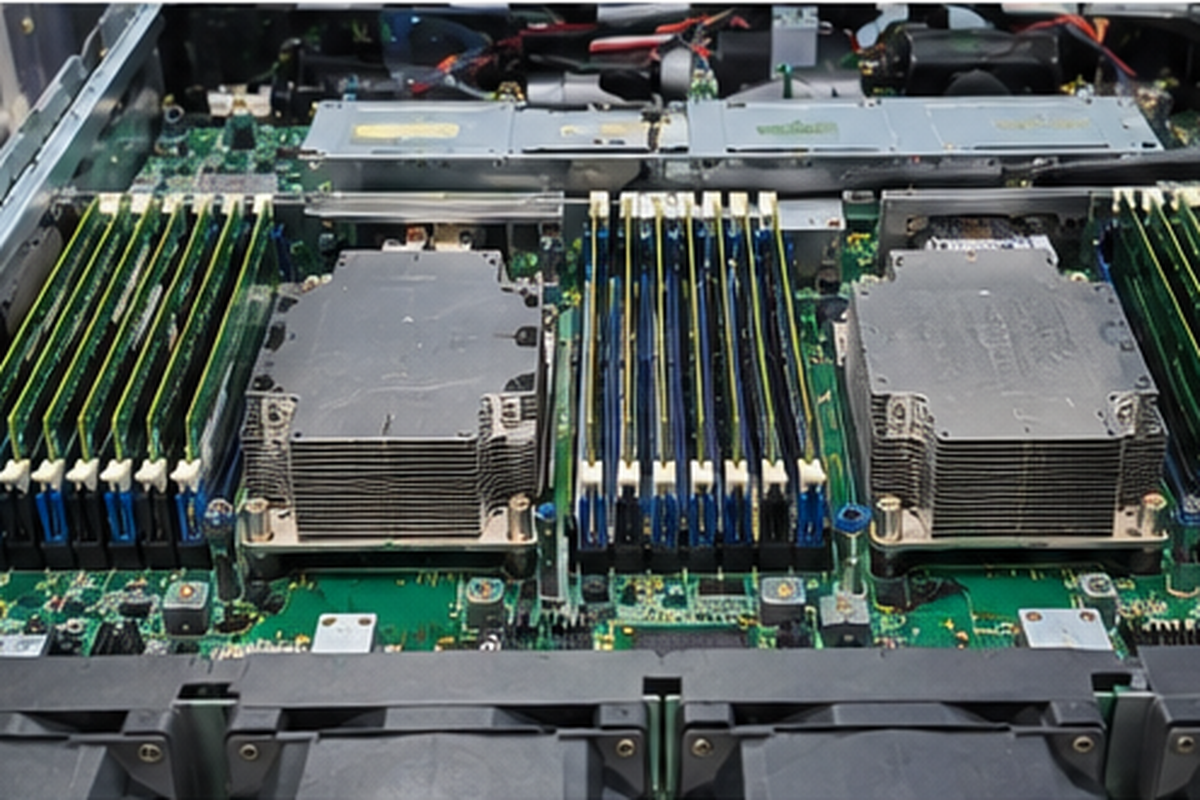
When reviewing bills of materials (BOMs) for global system integrators, I consistently notice confusion around these memory standards. Selecting the wrong module type causes costly deployment delays and unstable deployments. Let us examine the architectural differences and procurement considerations that define dependable enterprise infrastructure.
Why is ECC not the only factor in server RAM?
Relying solely on an error-correction label often leaves system builders stranded with unbootable chassis during field deployment. Many buyers believe ECC unbuffered memory transforms any consumer board into an enterprise platform. This assumption ignores the immense electrical load multi-socket enterprise platforms place on memory controllers.
ECC detects and corrects single-bit errors, but true enterprise platforms require physical memory registers to manage electrical capacitance across high-density motherboards. Without physical registers found in enterprise-grade modules, memory buses cannot maintain signal integrity when handling dozens of memory slots across multiple CPU channels, leading directly to bus degradation and system crashes.
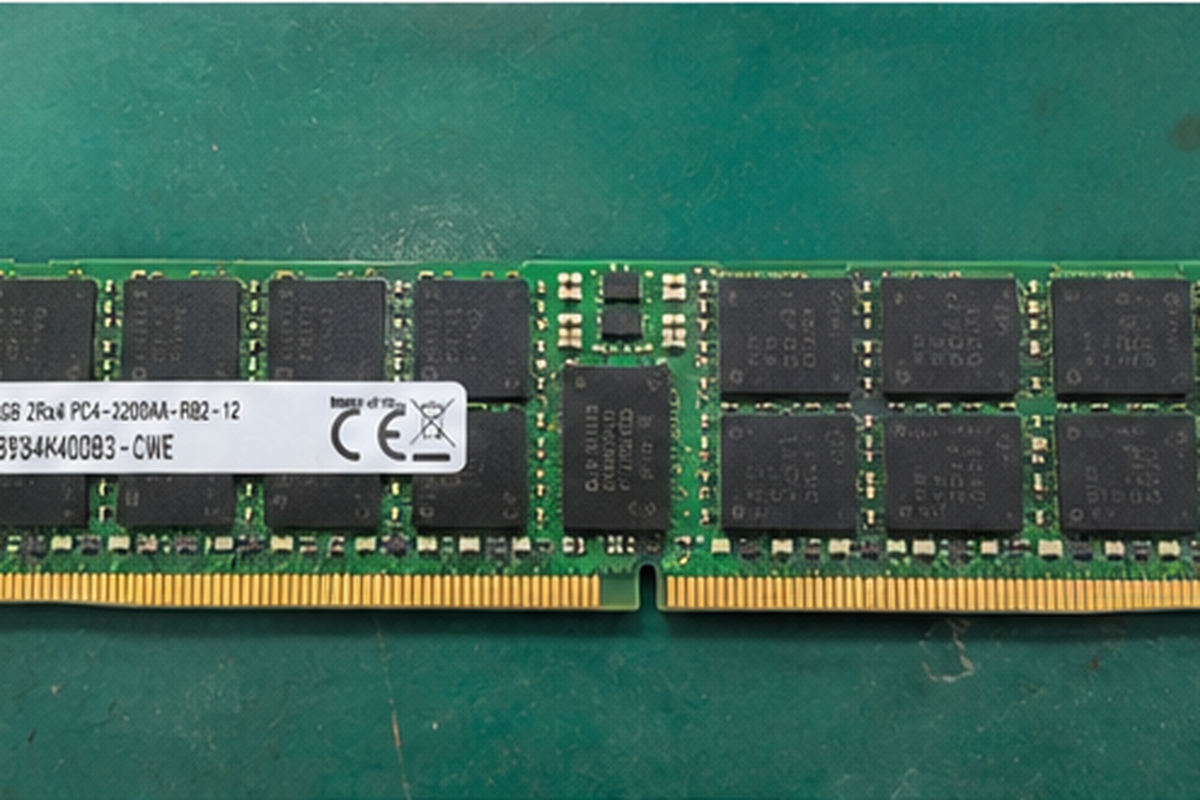
In client configurations, the most frequent pitfall we see is sourcing unbuffered ECC memory (ECC UDIMMs) for dual-socket compute nodes. While ECC UDIMMs offer parity bits to catch random soft errors caused by cosmic rays or electrical noise[^1], they place their full capacitive load directly on the central processor's integrated memory controller (IMC).
Soft Errors vs. Signal Degradation
A standard desktop processor typically addresses two memory channels with two slots each. Enterprise CPUs, such as modern Intel Xeon Scalable or AMD EPYC platforms, route memory through 8 to 12 channels per socket. When multiple unbuffered DIMMs share these channels, trace capacitance distorts command and address signals.
Enterprise infrastructure addresses this through structural buffering rather than algorithmic error checks alone:
- Error-Correcting Code (ECC): Adds an extra 8 bits of data per 64-bit word to calculate parity algorithms[^2]. It detects multi-bit errors and automatically corrects single-bit errors on the fly without interrupting the operating system.
- Command/Address Buffering: Places a hardware register chip between the CPU memory controller and the dynamic random-access memory (DRAM) chips. This isolates the CPU from the electrical capacitance of individual memory chips.
| Memory Attribute | Consumer Desktop RAM | ECC UDIMM | Enterprise RDIMM |
|---|---|---|---|
| Error Correction | None (Non-ECC) | Single-Bit Correction | Single-Bit Correction + Advanced Parity |
| Buffering Architecture | Completely Unbuffered | Completely Unbuffered | Buffered Address/Command Bus |
| Electrical Load on CPU | High per chip | High per chip | Low (Single load per register) |
| Maximum System Density | Limited (Up to 128GB) | Moderate (Up to 128GB) | High (Multiple Terabytes per node) |
| Platform Target | Workstations & Gaming | Entry Micro-servers | Enterprise Data Centers & High-Density Clouds |
When server memory buses experience excessive trace capacitance, the motherboard BIOS automatically scales down operational clock speeds to maintain clock edges. In worse scenarios, the system halts with pre-boot initialization errors. True enterprise infrastructure relies on combined error correction and electrical isolation to prevent catastrophic outages.
What are the primary types of server RAM modules?
Mismatched memory architectures can stall an entire data center rollout before the operating system even installs. Integrating incompatible module generations or mixing buffering technologies risks expensive procurement rework and project delays. Understanding the core module categories eliminates compatibility guesswork before issuing purchase orders.
The three main types of enterprise memory are Unbuffered DIMMs (UDIMMs), Registered DIMMs (RDIMMs), and Load-Reduced DIMMs (LRDIMMs). Enterprise platforms overwhelmingly deploy RDIMMs for balanced density and low latency, while high-capacity virtualization and database clusters utilize LRDIMMs to maximize rank counts and total gigabytes per channel.

Selecting between these module types is not a matter of speed. It represents a balancing act between memory density, latency, and bus capacitance. When our engineering team evaluates custom server configurations for wholesale clients, we always isolate the memory architecture by looking at slot-loading requirements.
Registered DIMMs (RDIMMs): The Enterprise Workhorse
RDIMMs integrate an onboard hardware register between the CPU and the memory chips. This register buffers only the command and address signal lines. The data lines remain directly connected between the memory controller and the DRAM chips.
Because command lines are buffered, the memory controller sees only a single electrical load per module rather than a separate load for every individual DRAM chip[^3]. This single-load characteristic allows enterprise servers to maintain high clock frequencies even when populating two modules per channel across 16 or 32 physical slots. RDIMMs add approximately one clock cycle of latency to command operations[^4], but this minor overhead is easily offset by the vast stability gains in multi-threaded environments.
Load-Reduced DIMMs (LRDIMMs): Maximum Density at Scale
While RDIMMs buffer command and address signals, they still leave data paths unbuffered. In high-density workloads, data line loading restricts how many physical memory ranks you can install without forcing the platform to down-clock drastically.
LRDIMMs resolve this limitation by replacing the basic register with an advanced memory buffer (or distributed data buffers on DDR4 and DDR5 platforms)[^5]. This buffer abstracts both the command signals and the physical data lines:
- The CPU memory controller communicates with the buffer chip as if it were a single logical rank.
- The buffer manages the reads and writes across physical multi-rank DRAM chips independently.
- Integrators can populate high-density quad-rank or octal-rank modules across every slot on the board.
CPU Memory Controller
   │
   ├─► [RDIMM]  ──► Command Register (Buffered) ──► DRAM Chips
   │            ──► Data Lines (Direct Electrical Load) ──► DRAM Chips
   │
   └─► [LRDIMM] ──► Command/Data Memory Buffer ──► All DRAM Chips (Fully Isolated)
For large hypervisors hosting dense virtual machine environments, LRDIMMs unlock memory capacities that standard RDIMMs cannot support on a single motherboard.
How do channel topologies affect server RAM performance?
Populating memory slots incorrectly can slash memory throughput by half without throwing a single visual error. System integrators often spread modules randomly across slots, creating unbalanced channels that throttle CPU pipelines. Achieving optimal throughput requires precise alignment with motherboard population matrices and processor layout rules.
Channel topologies dictate how processors access memory lanes, with modern multi-socket server CPUs offering 8-channel or 12-channel architectures. Populating memory symmetrically across all channels ensures maximum bandwidth, whereas unbalanced slot configurations force the memory controller to down-clock frequencies, degrade overall throughput, and increase workload latency.
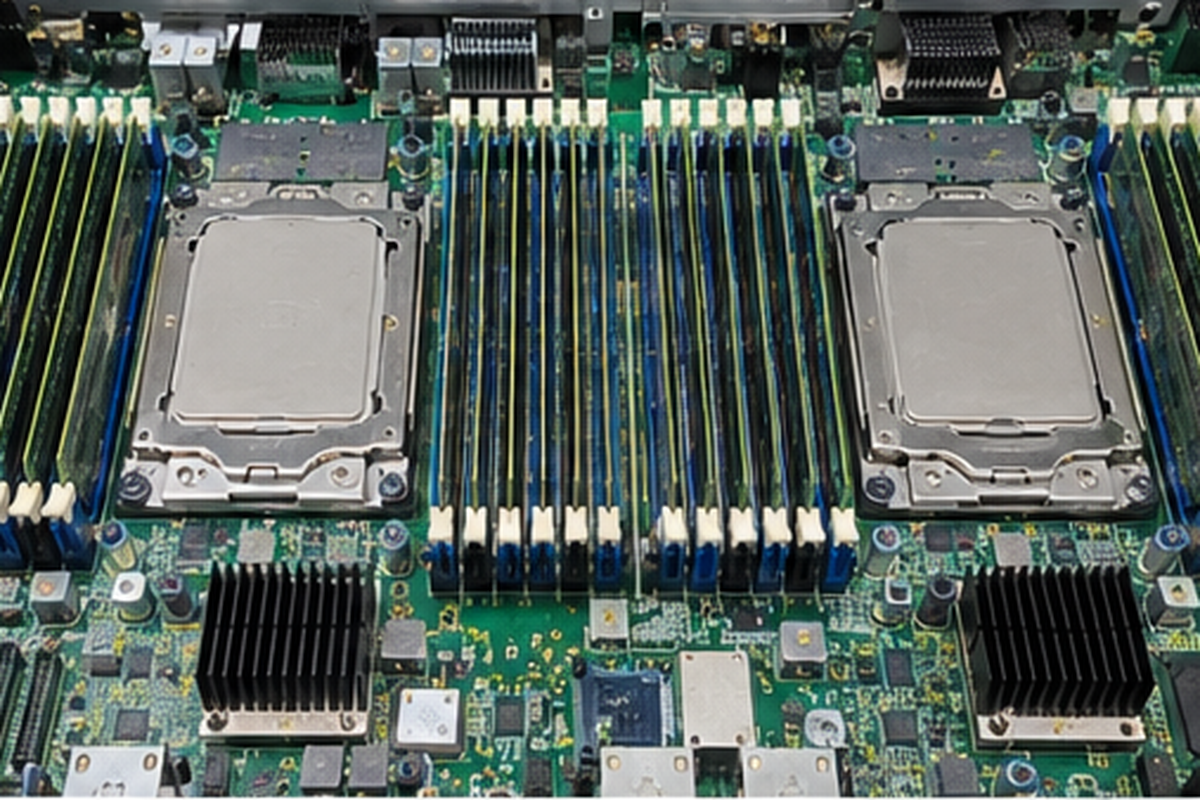
A common issue I see in custom hardware assembly involves unbalanced memory configurations. A customer might order a high-end 64-core enterprise processor but only purchase four modules to trim initial costs. While the server boots without errors, the CPU cannot leverage its native memory bandwidth.
Symmetrical Loading and Channel Interleaving
Modern enterprise processors do not access memory in a single pool. Instead, they divide physical memory across independent 64-bit buses known as channels.
- AMD EPYC Genoa/Bergamo: Features 12 memory channels per CPU socket[^6].
- Intel Xeon Scalable (Sapphire Rapids/Emerald Rapids): Features 8 memory channels per CPU socket[^7].
To achieve maximum performance, memory must be installed in balanced sets matching the processor's native channel count. When an operator populates all channels symmetrically, the memory controller executes memory interleaving. This technique distributes data blocks evenly across all memory channels simultaneously[^8], dramatically multiplying read and write throughput.
Interleaved Architecture (Full Bandwidth):
[Channel A] ── Block 0, 8, 16...
[Channel B] ── Block 1, 9, 17...
[Channel C] ── Block 2, 10, 18...
[Channel D] ── Block 3, 11, 19...
If memory is distributed unevenly, the controller disables interleaving across the mismatched channels, causing localized memory access bottlenecks and unpredictable performance spikes.
The Impact of Slot Population Density (1 DPC vs. 2 DPC)
Motherboard designs typically offer either one DIMM per channel (1 DPC) or two DIMMs per channel (2 DPC). While 2 DPC boards provide double the physical slots, installing two modules on the same channel increases electrical trace capacitance.
On many server platforms, running 2 DPC configurations forces the platform BIOS to reduce operational memory frequencies[^9] (for example, stepping down from 4800 MT/s to 4400 MT/s or lower). Sourcing engineers must determine whether their target application values pure raw capacity over sustained megatransfers per second before finalizing hardware orders.
How should enterprise buyers select the right server RAM?
Navigating hundreds of vendor part numbers without a clear specification strategy leads to overspending or underpowered infrastructure. Procurement managers frequently overpay for high peak megatransfers that the host CPU cannot sustain across fully populated banks. A structured workload evaluation protects operational budgets and prevents downstream operational bottlenecks.
Enterprise buyers select memory by reverse-engineering specific workload demands against CPU platform compatibility documents. Databases prioritize high speed and low latency across balanced RDIMMs, whereas dense hypervisors require high-capacity LRDIMMs. Always verify qualified vendor lists (QVL) and manufacturer platform documentation rather than relying strictly on nominal specifications.
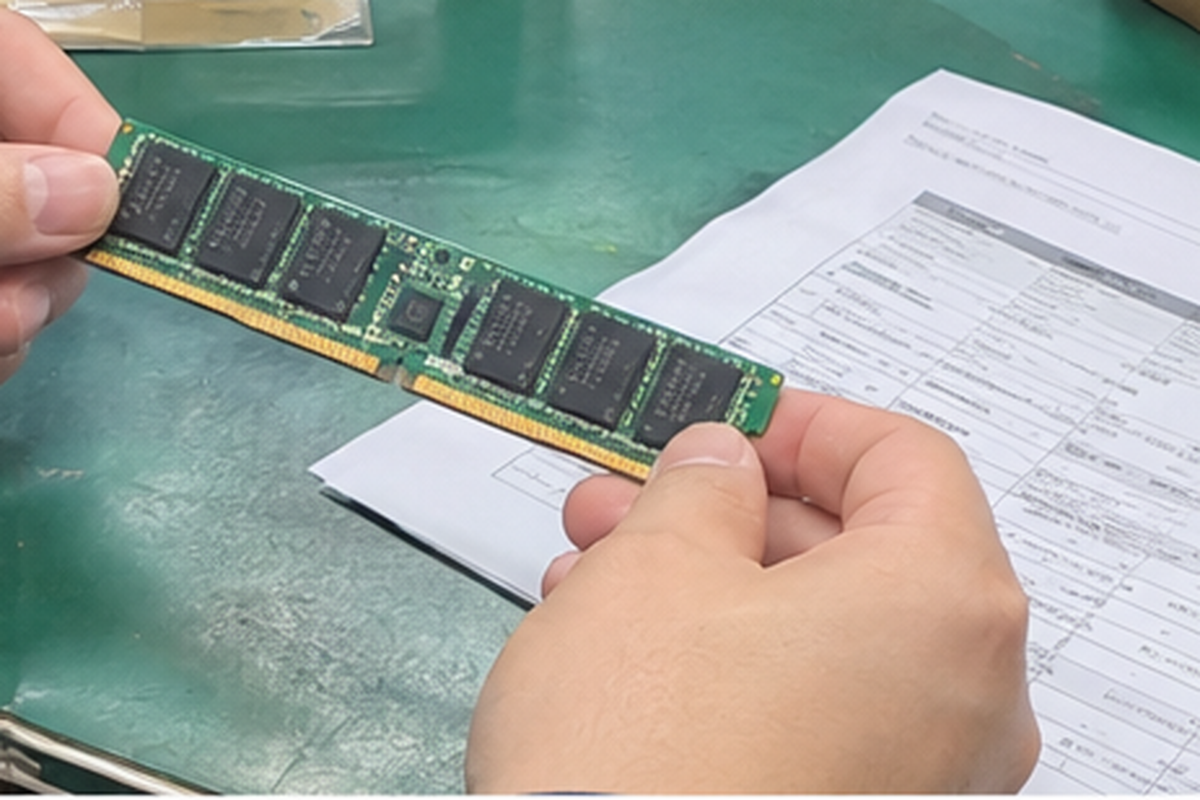
Procurement decisions should center on system application profiles rather than raw hardware spec sheets. When evaluating component choices for OEM platform builds, our teams evaluate client workloads against specific platform boundaries.
Workload-Driven Selection Criteria
Different enterprise applications stress memory subsystems in distinct ways:
- In-Memory Databases (e.g., SAP HANA, Redis): Require low memory access latency and maximum sustained bandwidth. Balanced configurations using mid-capacity RDIMMs running at native processor frequencies provide the fastest data throughput.
- Dense Virtualization Clusters (e.g., VMware ESXi, Proxmox): Prioritize raw gigabyte density over clock speed. LRDIMMs or high-density dual-rank RDIMMs are essential to prevent core-to-memory starvation.
- Edge Compute and Appliances: Typically operate in thermally constrained or harsh environments. These nodes require standard industrial-temperature RDIMMs that deliver high operational stability under fluctuating ambient conditions.
Procurement Rule: Never assume a retail module will run at advertised speeds inside a multi-socket platform. The processor model and memory population count establish the operational ceiling, regardless of module capability.
Enterprise Verification and Supply Chain Validation
Enterprise memory failures impact total cost of ownership through unexpected data center service tickets and hardware replacements. Buyers should enforce strict qualification criteria:
- Platform QVL Verification: Ensure the target module model number is listed on the motherboard manufacturer’s Qualified Vendor List (QVL) for that specific CPU family.
- Thermal Design Alignment: High-density modules (especially 64GB and 128GB LRDIMMs) generate significant heat. Chassis fan curves and internal baffles must provide adequate linear feet per minute (LFM) of airflow across the DIMM slots.
- Component Consistency: Tier-1 memory modules source consistent DRAM die revisions. Mixing different silicon revisions within the same channel, even under identical manufacturer part numbers, can introduce unpredictable memory timing errors.
Working with an experienced hardware partner ensures modules are verified, matched by rank, and burned in under industrial workloads before mass deployment.
Frequently Asked Questions
Can you use desktop RAM in a server motherboard?
No, most enterprise server motherboards will not boot with standard consumer unbuffered, non-ECC desktop RAM. Enterprise processor sockets and server chipsets strictly require memory with hardware error correction (ECC) and command registers (RDIMMs) to ensure system stability and signal integrity across complex motherboard trace layouts.
Can you mix RDIMM and LRDIMM modules in the same server?
No, you cannot operate RDIMMs and LRDIMMs simultaneously within the same physical server. Although they may share the same physical pin layout, their electrical architectures and internal buffering methods differ completely. Attempting to mix RDIMMs and LRDIMMs causes severe memory initialization errors, preventing the platform from completing POST.
What is the difference between DDR4 and DDR5 server RAM?
DDR5 memory provides twice the baseline bandwidth of DDR4[^10] and moves the Power Management Integrated Circuit (PMIC) directly onto the memory module itself[^11]. Additionally, DDR5 introduces on-die ECC inside the DRAM chips for localized error control[^12], complementing enterprise sideband ECC for end-to-end data safety.
Why does server RAM run at lower clock speeds than gaming RAM?
Enterprise memory prioritizes continuous electrical stability, thermal durability, and absolute data integrity over aggressive clock frequencies. Running memory at extreme transfer rates increases electrical noise and thermal dissipation. Lower clock frequencies allow memory controllers to reliably manage dozens of simultaneous channels without signal degradation or component wear.
Conclusion
Determining what kind of memory your systems need requires balancing density, buffering architecture, and processor channel alignment. Choosing enterprise server RAM involves far more than simply selecting an error-correcting module; it is a fundamental architectural decision that safeguards your platforms against data corruption and system downtime. By matching RDIMMs or LRDIMMs to your workload requirements and adhering to verified population guidelines, you protect long-term infrastructure stability.
If you are planning a server hardware refresh or need reliable, custom-engineered compute platforms, our engineering team can help. We design, validate, and manufacture enterprise-grade servers and data center infrastructure tailored to your exact operational specifications. Contact us today to discuss your configuration requirements and ensure dependable, long-term deployment success.
[^1]: "Soft error", https://en.wikipedia.org/wiki/Soft_error. Semiconductor reliability literature demonstrates that atmospheric neutron flux and alpha particle emissions from packaging materials induce single-event upsets in dynamic RAM. Evidence role: mechanism; source type: paper. Supports: Atmospheric neutrons from cosmic radiation and electrical noise cause transient single-event upsets in semiconductor memory cells.. Scope note: Experimental error rates vary significantly depending on altitude, manufacturing process node, and device capacitance. [^2]: "Hamming code", https://en.wikipedia.org/wiki/Hamming_code. Coding theory applied to computer memory specifies that an 8-bit syndrome code across a 64-bit data bus provides single-bit error correction and double-bit error detection. Evidence role: mechanism; source type: paper. Supports: Standard SEC-DED memory architectures implement 72-bit arrays combining 64 data bits with an 8-bit parity check matrix.. Scope note: Advanced Chipkill and multi-symbol correction schemes may employ alternative word and symbol parity configurations. [^3]: "Registered memory", https://en.wikipedia.org/wiki/Registered_memory. JEDEC standard memory module specifications define registered DIMMs as incorporating a register driver that presents only one unit load per command/address pin to the host controller. Evidence role: mechanism; source type: institution. Supports: RDIMM register phase-locked loops and buffer ICs isolate the command/address bus from individual DRAM pin capacitances.. [^4]: "Registered memory", https://en.wikipedia.org/wiki/Registered_memory. Memory interface analyses document that the registering clock driver re-times input command and address signals, introducing exactly one clock cycle of operational delay before reaching DRAM chips. Evidence role: mechanism; source type: research. Supports: The register on an RDIMM re-drives address and command signals with a fixed one-cycle pipeline delay.. Scope note: This latency affects only command and address re-timing, leaving raw CAS data access latencies governed by individual DRAM timings. [^5]: "DDR4 SDRAM", https://en.wikipedia.org/wiki/DDR4_SDRAM. JEDEC Solid State Technology Association standards specify distributed data buffers on modern LRDIMMs to isolate both data strobes and data lines from the host controller. Evidence role: mechanism; source type: institution. Supports: DDR4 and DDR5 LRDIMM standards transitioned from centralized buffer chips to distributed data buffers alongside a registering clock driver.. [^6]: "Epyc", https://en.wikipedia.org/wiki/Epyc. Microprocessor architectural analyses confirm that AMD EPYC 9004 series processors integrate 12 independent DDR5 memory channels per socket interface. Evidence role: statistic; source type: research. Supports: AMD 4th Generation EPYC processors incorporate 12 native DDR5 channels per socket.. [^7]: "Sapphire Rapids", https://en.wikipedia.org/wiki/Sapphire_Rapids. Processor architecture disclosures establish that Intel Sapphire Rapids and Emerald Rapids platforms utilize an 8-channel DDR5 memory topology supporting up to two DIMMs per channel. Evidence role: statistic; source type: research. Supports: Intel 4th and 5th Generation Xeon Scalable processors feature an 8-channel DDR5 memory subsystem.. [^8]: "Multi-channel memory architecture", https://en.wikipedia.org/wiki/Multi-channel_memory_architecture. Computer systems engineering principles establish that multi-channel interleaving maps sequential cache lines to separate memory controllers, overlapping access latencies and multiplying transfer bandwidth. Evidence role: mechanism; source type: paper. Supports: Memory channel interleaving spreads contiguous physical addresses across distinct channels to maximize aggregate memory bandwidth.. [^9]: "Am I interpreting this 1DPC vs 2DPC table correctly : r/buildapc", https://www.reddit.com/r/buildapc/comments/164de1v/am_i_interpreting_this_1dpc_vs_2dpc_table/. Platform signal integrity analyses show that stub reflections and increased trace capacitance in two-DIMM-per-channel configurations mandate reductions in maximum operational transfer rates. Evidence role: mechanism; source type: research. Supports: Higher capacitive loading and signal degradation in 2 DPC layouts require platforms to de-rate operating clock rates.. Scope note: Maximum supported 2 DPC frequencies depend heavily on board layer count, routing topology, and processor memory controller silicon stepping. [^10]: "DDR5 SDRAM", https://en.wikipedia.org/wiki/DDR5_SDRAM. Standard memory specifications by JEDEC publish baseline DDR5 data rates starting at 4.8 GT/s compared to baseline DDR4 launch rates of 2.4 GT/s, effectively doubling peak theoretical channel bandwidth. Evidence role: statistic; source type: institution. Supports: JEDEC specifications define DDR5 baseline launch data rates starting at 4800 MT/s, doubling the DDR4 baseline of 2400 MT/s.. Scope note: Effective application-level bandwidth scaling depends on bus efficiency, memory controller scheduling, and cache line access patterns. [^11]: "Suggested DC/DC Converters and PMIC for Powering DDR5, LPDDR5, ...", https://www.ti.com/lit/pdf/sbaa792. JEDEC DDR5 specifications stipulate that 12V power distribution is stepped down directly on the module via a dedicated PMIC to improve power integrity and transient load handling. Evidence role: mechanism; source type: institution. Supports: DDR5 standard specifications mandate an on-DIMM PMIC rather than motherboard-based voltage regulators.. [^12]: "What are the advantages of on-die ECC vs side-band ECC? : r/homelab", https://www.reddit.com/r/homelab/comments/17xu4e7/what_are_the_advantages_of_ondie_ecc_vs_sideband/. DRAM architecture analyses indicate that DDR5 includes internal on-die ECC engines to manage increasing cell failure rates at smaller lithographies, operating independently of system-level sideband ECC. Evidence role: mechanism; source type: paper. Supports: DDR5 incorporates on-die ECC within individual DRAM dies to maintain cell reliability at sub-micron fabrication nodes.. Scope note: On-die ECC does not protect data in transit across the memory bus between the DRAM die and the processor memory controller.
发表回复