

Understanding the technical difference between RAM and […]
Understanding the technical difference between RAM and server RAM often becomes an urgent priority only after an unbuffered module crashes an enterprise system. Standard desktop memory is affordable and fast, but deploying it inside 24/7 business infrastructure introduces severe operational risks. In my work consulting on custom server hardware builds, I help procurement teams evaluate memory architectures to secure enterprise uptime before committing capital to production runs.
The primary difference between RAM and server RAM lies in error protection, architectural buffering, and operational resilience under continuous workloads. Standard desktop RAM prioritizes raw clock speed and low latency for personal computing. Server RAM integrates Error-Correcting Code (ECC) technology and register buffers to detect and correct memory faults, preventing system crashes and silent data corruption in 24/7 enterprise infrastructure.
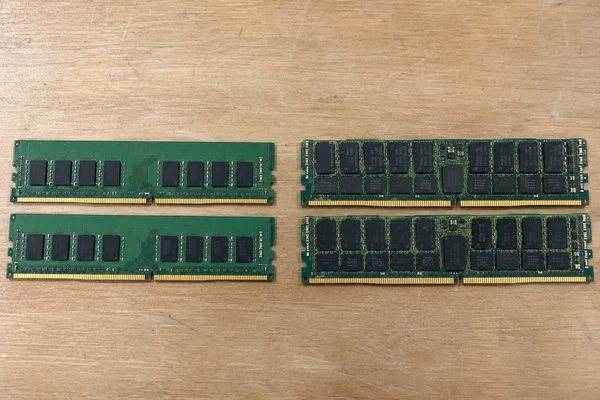
Many hardware buyers assume memory modules are interchangeable commodities across all computing platforms. In pre-sales engineering calls, I regularly encounter clients who hope to lower their initial bill of materials by substituting desktop sticks into server boards. Let us examine the architectural and financial realities that make server-grade memory indispensable for enterprise deployments.
Why does the difference between RAM and server RAM impact system reliability?
Silent data corruption can destroy database integrity without triggering any immediate system warnings. Unchecked soft errors from electrical noise or cosmic background radiation routinely flip bits in active memory cells.[^1] In customer inquiries, a common misconception is that software can safely catch these hardware faults before transactions write to persistent storage.
Server memory maintains system reliability by deploying Error-Correcting Code (ECC) algorithms and dedicated parity chips directly onto the module circuit board. When electrical interference causes a single-bit flip, server RAM identifies and corrects the anomaly instantly in real time. Standard consumer RAM lacks parity checking and promptly crashes the operating system with a fatal kernel panic.
The Silent Threat of Single-Bit Flips
Microscopic electrical charges represent binary data inside dynamic volatile memory. These electrical states are vulnerable to external physical interference. Cosmic rays, magnetic fluctuations, and thermal spikes frequently trigger Single-Event Upsets (SEUs)[^2]. A single-event upset flips a binary 1 to a 0, or vice versa.
In a gaming desktop, a flipped bit might cause an imperceptible texture glitch or close an application. In an enterprise storage node or financial transaction engine, that same bit flip alters customer balances, corrupts file allocation tables, or halts virtual machines.
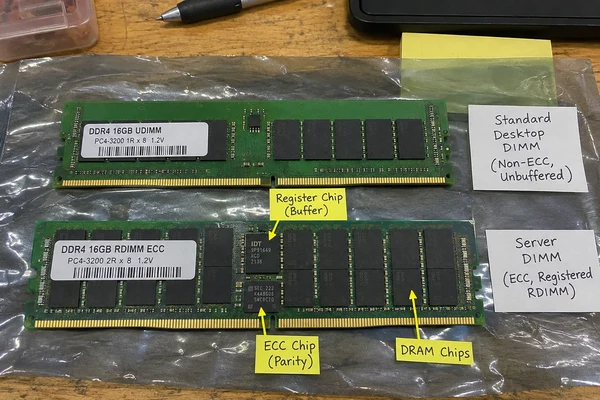
Server RAM mitigates this vulnerability by using Hamming codes via an extra memory chip[^3] on the printed circuit board. Standard consumer memory uses eight memory chips per side to transfer 64 bits of data per channel. Server ECC memory adds a ninth chip to deliver a 72-bit bus. The extra eight bits store cryptographic parity checksums.
Through Single Error Correction and Double Error Detection (SECDED)[^4], the memory subsystem corrects any isolated single-bit fault without interrupting the CPU. It also logs double-bit errors to system event logs, enabling predictive maintenance before catastrophic system crashes occur.
| Parameter | Standard Desktop RAM (Non-ECC UDIMM) | Enterprise Server RAM (ECC RDIMM / LRDIMM) |
|---|---|---|
| Error Handling | None (crashes on memory fault) | Hardware-level SECDED ECC parity |
| Data Bus Width | 64 bits per channel | 72 bits per channel (64-bit data + 8-bit parity) |
| Silent Corruption Risk | High under sustained 24/7 runtimes | Extremely low (detected and corrected in real time) |
| Target Duty Cycle | 8 to 12 hours daily intermittent use | 24/7/365 continuous heavy enterprise loading |
| Thermal Rating | Standard ambient commercial cooling | Industrial-grade thermal binning with heat spreaders |
Operational Duty Cycles and Thermal Endurance
Enterprise compute nodes operate in compact chassis environments where intake temperatures and thermal density run substantially higher than consumer towers. Standard consumer RAM is engineered for intermittent consumer duty cycles. These sticks rarely run at sustained memory saturation across multiple consecutive days.
In contrast, server-grade modules undergo stringent factory binning for industrial thermal endurance. Manufacturers subject these components to continuous thermal-chamber burn-in tests to guarantee signal integrity under high ambient heat. This physical endurance prevents thermal throttling and signal degradation across years of continuous deployment.
How does architecture dictate the difference between RAM and server RAM compatibility?
System integrators often ask if consumer RAM can fit into server motherboards to save budget on initial builds. Forcing unbuffered consumer memory into enterprise sockets leads to unbootable nodes, system hangs, and wasted integration labor. Architectural compatibility requires aligned hardware across the CPU memory controller, motherboard firmware, and physical trace layouts.
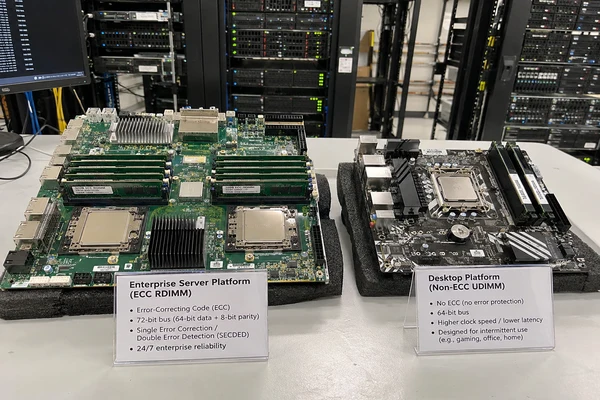
The physical difference between RAM and server RAM involves memory registers, electrical loading buffers, and specialized pin assignments. Standard desktop memory connects directly to the CPU memory controller, limiting total module capacity. Server memory utilizes register chips or full memory buffers to stabilize electrical signals, allowing enterprise platforms to support terabytes of dense system memory safely.
Registered and Load-Reduced Architectures Explained
Consumer memory is almost universally unbuffered (UDIMM)[^5]. Each DRAM chip on a UDIMM connects directly to the CPU memory controller. As you add more memory sticks to a channel, the electrical capacitance on the memory bus increases dramatically. Consumer CPUs typically become unstable or downclock memory speeds if you populate more than two memory slots per channel[^6].
Enterprise servers solve this physical bottleneck by utilizing Registered DIMMs (RDIMMs) or Load-Reduced DIMMs (LRDIMMs)[^7]:
- Registered DIMMs (RDIMMs): These modules feature a dedicated hardware chip called a Registering Clock Driver (RCD)[^8]. The RCD buffers command and address signals between the memory controller and the DRAM chips. This buffering relieves electrical strain on the processor memory bus, enabling stable operation across four, eight, or sixteen memory slots per motherboard socket.
- Load-Reduced DIMMs (LRDIMMs): For ultra-dense compute nodes, LRDIMMs replace simple register chips with comprehensive data buffers. These buffers handle command, address, and data lines simultaneously. The CPU memory controller perceives only a single electrical load per module, regardless of how many physical DRAM ranks reside on the stick.
Engineering Takeaway: While standard unbuffered memory modules hit capacity ceilings quickly, registered and load-reduced server architectures permit memory expansion up to multiple terabytes per multi-socket server node without dropping bus frequency or causing signal reflection.
Memory Controller and Socket Constraints
Even when desktop memory shares the same physical pin count as server RAM (such as 288-pin DDR4 or DDR5 formats), electrical and firmware definitions differ completely. Enterprise server processors, such as Intel Xeon or AMD EPYC, require register handshakes from the RCD to complete the Power-On Self-Test (POST). Installing unbuffered consumer sticks into these enterprise boards leaves the server unbootable.
Similarly, consumer motherboards and retail CPUs rarely contain trace routing or microcode routines to address register buffers. Hardware teams cannot treat memory selection as an arbitrary line item. The memory controller, printed circuit board trace topology, and system BIOS must match the chosen memory topology precisely.
What financial metrics justify the cost difference between RAM and server RAM?
Procurement managers face intense pressure to trim server Bill of Materials (BOM) costs during large fleet purchases. Choosing standard consumer memory offers an enticing initial discount on line-item quotes. However, shaving hardware costs upfront often introduces devastating operational expenses down the road.
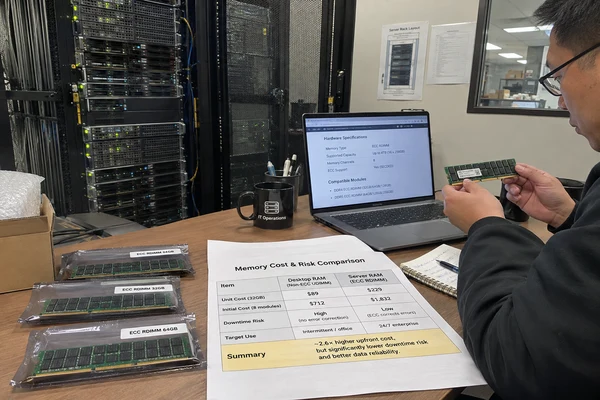
Enterprise server memory commands a higher purchase price due to extra silicon chips, registered clock drivers, rigorous thermal binning, and extensive validation testing. This price premium acts as operational insurance. It dramatically lowers the Total Cost of Ownership (TCO) by eliminating unplanned server reboots, unscheduled maintenance trips, and irreversible transaction database corruption.
Quantifying the True Cost of Memory Crashes
For an enterprise or hosting facility, calculating the true value of memory hardware requires modeling downtime risks. According to industry surveys, an hour of enterprise infrastructure downtime can cost hundreds of thousands of dollars[^9] in lost commerce, missed service-level agreement (SLA) penalties, and emergency engineering labor.
Consider an enterprise cluster managing transactional database queries:
- Direct Hardware Replacement Costs: A failed consumer module requires a technician to travel on-site, run hardware diagnostics, swap the stick, and verify system recovery. Labor costs quickly exceed the original price difference between RAM and server RAM.
- Corrupted Database Recovery: Non-ECC memory modules allow corrupted data blocks to write directly to enterprise SAN or NVMe storage arrays. Restoring data from raw transaction logs can take days of degraded performance.
- SLA Penalties and Reputational Damage: Service providers face contractual cash refunds when client systems drop offline due to memory parity faults. High-reliability server hardware protects your brand reputation and client retention metrics.
Multi-Year Lifecycles and Supply Chain Continuity
Consumer desktop memory markets prioritize rapid generational changes, aesthetic heatspreaders, and volatile overclocking specs. Consumer memory product codes frequently reach End-of-Life (EOL) within twelve to eighteen months[^10].
Enterprise server RAM follows conservative, standardized JEDEC specifications[^11] with locked component revisions. Production lifecycles span five to seven years for enterprise server platforms.
When you purchase validated server modules through an OEM/ODM manufacturing partner, you secure identical replacement parts for multi-year rollouts. This standardization eliminates mixed-stepping incompatibilities, simplifies warranty tracking, and ensures reliable fleet maintenance throughout the hardware lifecycle.
How should procurement teams evaluate server RAM for custom hardware builds?
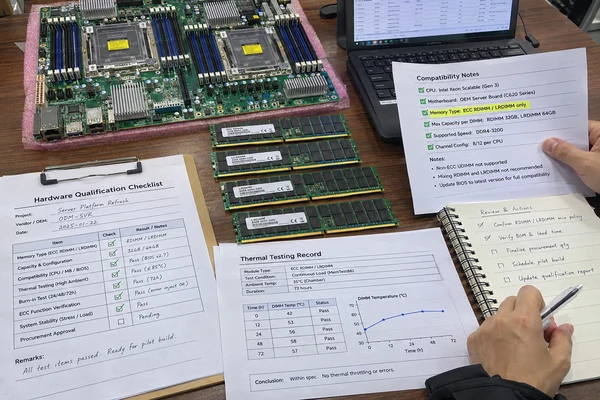
Selecting memory for custom OEM/ODM platforms requires balancing workload demands with long-term component availability. Buying the wrong module specification causes costly production delays, firmware redesigns, and RMA cycles. I always guide our clients through a structured qualification checklist before freezing component specifications on custom hardware builds.
Procurement teams must evaluate memory based on workload criticality, density scaling, thermal dissipation, and chipset compatibility. Mission-critical cloud workloads and enterprise databases require RDIMMs or LRDIMMs with full ECC support. Lightweight edge appliances or low-cost microservers might leverage ECC UDIMMs, but consumer non-ECC modules should remain restricted strictly to non-critical development testing.
Workload Profiling and Density Planning
Procurement managers should categorize incoming hardware deployments into clear functional tiers before selecting memory components. Not every project demands high-density LRDIMMs, but critical services must never run on non-ECC modules.
- Tier 1: Mission-Critical Databases, HPC, and Virtualization Hosts: These systems require maximum memory density and zero downtime tolerance. Choose multi-rank ECC RDIMMs or LRDIMMs validated across all channels. Populate all memory channels symmetrically to maximize memory throughput.
- Tier 2: Edge Computing and Industrial Gateways: Industrial edge nodes operate in harsh environments with fluctuating temperatures. These systems typically utilize moderate capacities. ECC UDIMMs or low-profile ECC SODIMMs provide error protection while keeping board space and thermal dissipation manageable.
- Tier 3: Internal Development and Non-Critical Test Stacks: Development nodes where data loss carries zero financial consequence can leverage standard unbuffered consumer RAM, assuming the motherboard chipset explicitly supports non-ECC operation.
Manufacturing Quality Control and Validation
When evaluating OEM/ODM manufacturing partners for custom enterprise servers, hardware buyers should verify how the supplier tests and sources memory. A dependable hardware supplier should provide documented quality control standards across four key operational areas:
- Component Sourcing: Direct partnerships with tier-one silicon foundries ensure genuine, unadulterated DRAM dies with transparent traceability.
- Compatibility Matrix Validation: Confirmation that memory modules are validated against specific motherboard models, socket configurations, and CPU steppings.
- Environmental Stress Screening: Factory-level burn-in testing under thermal load to weed out infant mortality defects prior to export shipping.
- Supply Chain Transparency: Guaranteed long-term availability commitments to prevent unexpected component revisions during active client contract cycles.
Frequently Asked Questions
Can you put server RAM in a regular desktop computer?
In most cases, you cannot install server RAM in a consumer desktop. Standard desktop motherboards and consumer CPUs lack the firmware support and electrical trace routing required to operate registered (RDIMM) or load-reduced (LRDIMM) modules. A desktop board will refuse to boot if you install registered server memory.
Does server RAM run slower than regular gaming RAM?
Server RAM often features slightly higher latency timings than specialized gaming memory. This latency trade-off occurs because registering clock drivers and error-checking circuits require extra clock cycles[^12] to verify data integrity. Server memory prioritizes absolute signal stability and data accuracy over aggressive clock frequency boosts.
Can you mix regular RAM and server RAM on the same motherboard?
You cannot mix unbuffered consumer RAM and registered server RAM within the same system. Memory controllers cannot process buffered and unbuffered signaling simultaneously. Even on specialized workstation motherboards that support both types of memory individually, system builders must populate the platform exclusively with one architecture.
How does ECC memory detect and correct errors?
ECC memory utilizes Hamming code checksum algorithms to monitor data transfers. The memory module writes extra parity bits for every 64 bits of data. When the CPU reads data back, the controller recalculates the parity code. If one bit flips, the hardware repairs it instantly on the fly.
Conclusion
The fundamental difference between RAM and server RAM is not a cosmetic speed benchmark, but an architectural commitment to business continuity. Standard desktop memory is engineered for low costs and consumer computing convenience. Server RAM is purpose-built to eliminate silent data corruption, maintain signal integrity across dense multi-channel arrays, and protect enterprise workloads from catastrophic downtime.
When you configure mission-critical computing, storage, or network platforms, cutting costs on memory specifications introduces unacceptable balance-sheet risk. At our OEM/ODM facilities, we design, test, and manufacture fully customized enterprise server hardware, redundant power systems, and high-density compute nodes built to your exact technical specifications. Contact our engineering team today to review your hardware requirements and ensure full compatibility for your next data center deployment.
[^1]: "Soft error", https://en.wikipedia.org/wiki/Soft_error. Large-scale field observations across enterprise server fleets demonstrate that DRAM error rates frequently exceed thousands of failures in time (FIT) per megabit, establishing that soft errors occur on an ongoing basis under normal operating conditions. Evidence role: statistic; source type: paper. Supports: Field studies of server memory across production fleets demonstrate that soft errors and single-bit faults occur at measurable rates in DRAM.. Scope note: Observed failure frequencies vary substantially based on component density, chip fabrication generation, and system workload profile. [^2]: "Terrestrial Cosmic Ray Induced Soft Errors and Large- ...", https://digitalcommons.usu.edu/cgi/viewcontent.cgi?article=1562&context=spacegrant. Semiconductor radiation research confirms that terrestrial neutron spallation reactions in silicon substrates generate localized electron-hole pairs that discharge memory storage nodes, producing single-event upsets. Evidence role: mechanism; source type: paper. Supports: Atmospheric neutron interactions with silicon nuclei generate ionizing charges capable of inverting the logic state of DRAM capacitors.. Scope note: Laboratory data derived from accelerated beam testing may not reflect exact terrestrial neutron fluxes across differing elevations. [^3]: "Hamming code", https://en.wikipedia.org/wiki/Hamming_code. Standard computing reference works describe the implementation of modified Hamming codes that utilize an additional 8 bits per 64-bit word to compute parity syndromes directly on the bus. Evidence role: mechanism; source type: encyclopedia. Supports: ECC memory modules use extended Hamming codes mapped across an extra memory chip on a 72-bit bus to detect and correct single-bit deviations.. [^4]: "ECC memory", https://en.wikipedia.org/wiki/ECC_memory. Foundational coding theory defines SECDED as an extended Hamming scheme with minimum distance 4, ensuring reliable single-error correction alongside deterministic detection of double-bit faults. Evidence role: definition; source type: paper. Supports: SECDED parity architecture transparently corrects single-bit errors while signaling uncorrectable multi-bit anomalies to the system.. [^5]: "JEDEC memory standards", https://en.wikipedia.org/wiki/JEDEC_memory_standards. JEDEC module specifications establish that unbuffered memory topologies route host memory controller buses directly to DRAM packages without intermediary register or retiming silicon. Evidence role: definition; source type: institution. Supports: JEDEC standards define UDIMMs as unbuffered modules where clock, address, and data signals connect directly between the DRAM chips and host controller.. [^6]: "DIMMs", https://en.wikipedia.org/wiki/DIMM. Processor memory implementation guidelines state that two DIMMs per channel (2 DPC) configurations with unbuffered memory introduce severe capacitive loading, necessitating lower operational data rates to maintain signal margins. Evidence role: mechanism; source type: other. Supports: Multi-DIMM per channel configurations in unbuffered topologies increase bus capacitance, requiring memory controller frequency step-downs.. Scope note: Specific frequency drops vary depending on motherboard PCB layer count, trace topology, and memory controller generation. [^7]: "Performance and Energy Benefits of MRDIMMs", https://arxiv.org/html/2605.02371v1. Technical analyses of high-density server architectures confirm that LRDIMMs substitute direct data-line routing with distributed memory buffers, converting physical multi-rank modules into a unified electrical load. Evidence role: mechanism; source type: paper. Supports: LRDIMM designs deploy data buffers to isolate both control and data lines from the host memory controller, enabling higher capacity scaling.. Scope note: The exact implementation of data buffer chips differs between DDR3, DDR4, and DDR5 JEDEC architectural specifications. [^8]: "RCD", https://www.jedec.org/category/keywords/rcd. Industry standards governing registered DIMMs specify that the Registering Clock Driver acts as a redriver for address and control lines, mitigating capacitive load buildup across multi-slot channels. Evidence role: mechanism; source type: institution. Supports: The RCD buffers and retimes command and address buses to present a single electrical load to the host memory controller.. [^9]: "ITIC Reports & Survey Results", https://itic-corp.com/itic-reports-surveys/. ITIC annual reliability surveys report that 91% of mid-sized and large enterprises estimate the hourly cost of unplanned infrastructure downtime exceeds $300,000, with mission-critical systems reporting significantly higher figures. Evidence role: statistic; source type: research. Supports: Industry downtime surveys establish that an hour of enterprise infrastructure outage frequently incurs hundreds of thousands of dollars in commercial and operational losses.. Scope note: Downtime valuation varies considerably by enterprise size, regulatory requirements, and revenue model. [^10]: "Micron Announces Exit from Crucial Consumer Business", https://investors.micron.com/news/press-release/2025/Micron-Announces-Exit-from-Crucial-Consumer-Business-12-03-2025/default.aspx. Semiconductor market research shows that consumer PC DRAM SKUs face brief lifecycles driven by rapid retail pricing changes, resulting in component obsolescence cycles significantly shorter than enterprise platforms. Evidence role: general_support; source type: research. Supports: Consumer memory products exhibit brief commercial lifecycles compared to enterprise hardware with multi-year roadmap guarantees.. Scope note: Specific product lifespans depend on individual DRAM manufacturer silicon production schedules and third-party module branding strategies. [^11]: "JEDEC memory standards", https://en.wikipedia.org/wiki/JEDEC_memory_standards. JEDEC Solid State Technology Association publications establish standardized pinouts, serial presence detect (SPD) contents, and signal integrity requirements across server memory generations. Evidence role: definition; source type: institution. Supports: JEDEC is the global semiconductor standards body defining electrical signaling, pinouts, and physical specifications for server memory.. [^12]: "RCD", https://www.jedec.org/category/keywords/rcd. Architectural benchmarks confirm that the register buffer on an RDIMM incurs a deterministic one-cycle delay to re-clock address and control inputs, while ECC verification logic introduces minor latency at the memory controller. Evidence role: mechanism; source type: paper. Supports: Command/address register buffering and ECC syndrome generation add 1 to 2 clock cycles of access latency compared to unbuffered consumer modules.. Scope note: The net operational throughput impact is often mitigated in enterprise servers by wider multi-channel configurations and deeper memory command queues.
发表回复